
CHANGING HOW HOSPITALITY DOES SOCIAL

IGTV Changes the Way Users Interact With Visual Content

In less than a decade, Instagram has grown into a global community of one billion with its average user spending 53 minutes per day on the app. Understanding the ever-evolving nature of social, one can’t help but attribute this Insta-success story to its ability to quickly adapt to the latest trends, the most recent being vertical video.

Instagram predicts that mobile video will account for 78% of total mobile data traffic by 2021. While video content is currently thriving on Instagram Stories, users are limited to 60 seconds per video. So, what’s next? As it turns out, it’s already here—join us as we tune into the world of IGTV.

What is IGTV?

As of now, a lot of users simply know IGTV as the button they accidentally tapped in the upper-righthand corner of Instagram. If you fall into this category, we hope the following insight will provide further clarification.

IGTV is an optimized mobile video platform that brings users closer to the Insta-icons they love. What distinguishes this streaming platform from others of its kind is its vertical formatting.

Instagram cracked the code: if users are going to spend more time watching videos on their phones, the media should accommodate the technology’s intended upright position.

So, how is this different than Instagram Stories? We’re glad you asked. What sets IGTV apart is  the ability to upload longform content—up to one hour of video for verified accounts. Better yet, your videos will not disappear after 24 hours. While it’s easy to access within Instagram app, a separate IGTV app is available as well.

Just like your classic cable television, IGTV begins playing as soon as you open the app. It’s easy to flip through channels, browse for content, and multitask. The best part? There are no commercial breaks.

At first this may sound overwhelming, especially since a whopping one billion people can contribute to this new medium. But don’t fret, Instagram knows us better than that. The content that populates to each user’s screen is carefully curated based on accounts you already follow.

What opportunities does IGTV offer for businesses?

It probably comes as no surprise that the social media fanatics at BCV are jazzed about Instagram’s new extension. Now, individuals and businesses have the opportunity to showcase longform video content with a global community—especially those users with whom they have already established an online following.

In consideration of BCV’s area of expertise, the hospitality industry, 60 minutes of uninterrupted content will allow our clients to delve deeper into the discovery and storytelling aspects of travel.

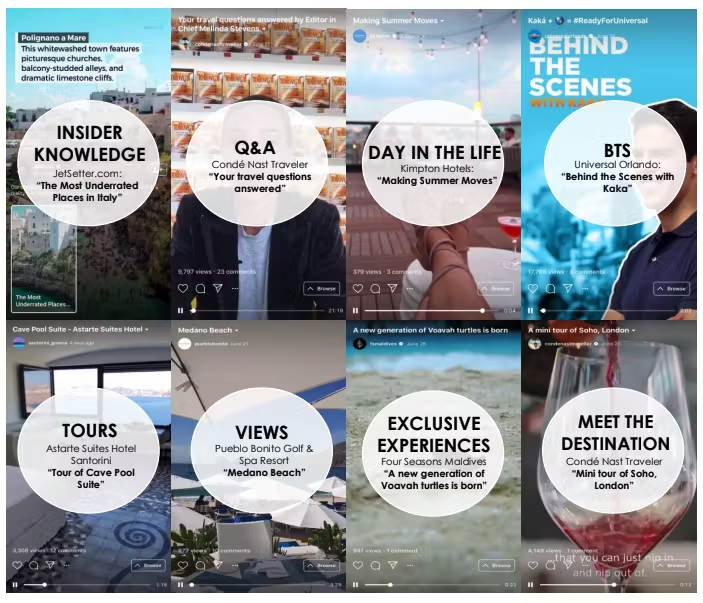
Need a visual? Let’s look at how other travel and hospitality businesses are using IGTV:
Where to Start?

First thing’s first, start by expanding your business’s vertical video library. For those who are eager to test out IGTV, try experimenting with recycled, high-performing assets from past Instagram Stories.

With discovery at the core of travel, IGTV offers a unique platform for hotels to connect with target audiences. Whether it’s a behind-the-scenes look into your executive chef preparing a lavish meal or an influencer spotlight—the opportunities are endless.

Final Thoughts

Vertical video is taking over and we’re loving it. Your friends at BCV are eager to see how IGTV continues to emerge as a social sharing platform, further allowing brands to form lasting connections with users.
Hashtags have been an invaluable social media tool, ever since its first use on Twitter, where social technology expert Chris Messina is credited to have come up with the very first hashtag, posting a tweet in 2007 reading: “How do you feel about using # (pound) for groups. As in #barcamp?” Messina created the hashtag with the intention to use it for aggregating discussions online regarding Barcamp, a user-generated technology conference around the world.

Exploding from its start on Twitter, hashtags have transcended their strictly social media use and can be found in today’s pop culture, fashion trends, and even on Jimmy Fallon. They have become infamous in society for satirizing social media and its importance in our everyday lives (#blessed). However, the fact remains that despite its pop culture reputation, hashtags are valuable components of a social media strategy.

There’s still an air of mystery surrounding hashtags: what are they actually used for? How many can you use? Which ones should you use? We sat down with members of our brand team to debunk the hashtag mystery and get insight for this social media enigma.

Why are hashtags so important for a brand’s social media strategy?

Hashtags act as a growth contributor; they expand your engagement, visibility, and, if used correctly, can increase your following. Placing a hashtag in an Instagram post not only gives the audience insight on the topic of the post, but also gives you the ability to join the conversation of that hashtag. For example, if you search the hashtag #onthetable, popular for food posts, you’ll see beautiful entrées, tables covered with dishes, and delectable desserts, all tagged with #onthetable. The benefit of a hashtag is that it’s a searchable, trackable tool—you’re able to find your post among the many included in that section and, more importantly, others are able to find it when they search that particular hashtag.

What are the benefits of hashtags?

Hashtags give you control of where your post goes, how it’s seen, and who sees it. Say you want to be associated with a certain luxury travel aesthetic. By tailoring your post with trending hashtags that focus on luxury travel, you can insert your brand into that particular online conversation. Another benefit of hashtags is the inspiration you can draw from them. Not only can a hashtag introduce you to a new brand or influencer with interesting social media techniques, but they can also help with trend forecasting. With Instagram always changing and evolving, what’s popular in January might not be popular in August.

Where should you use hashtags?

To fully take advantage of them, hashtags should be limited to social media, specifically Instagram. You’ll get the best usage out of hashtags when they’re accompanying an Instagram post, because it’s appropriate/accepted to include more than one in a post. When it comes to Twitter or Facebook, best practices recommend only using a hashtag if it is tailored for a specific campaign, content series, or brand, i.e. #TravelTipTuesday.

This is because Instagram users actively search the platform using the hashtag as a tool to find posts under a particular category. As a result, when you include more than one hashtag, you better your chances of being found through multiple searches. This practice also looks much cleaner in an Instagram post, where you’re able to hide multiple hashtags in the first comment of the post.

What are some Dos and Don’ts regarding hashtag best practices?

  • Do: Use them on Instagram with topics and inspiration you want to be associated with.

  • Don’t: go overboard with them (even though you can use up to 30 on a post, we don’t recommend using that many).

  • Do: Tag your overarching brand or slogan, especially if your brand has a parent hashtag (i.e. #MarriottHotels or #TravelBrilliantly)

  • Don’t: Use hashtags that are overly popular. If you have a breakfast post going out, we don’t recommend tagging the post with #eggs—that particular hashtag has over 10.5 million posts, and odds are your post won’t be seen.

  • Do: Include hashtags on Instagram Stories. They’ll aggregate into a larger conversation that lives outside your feed and your followers.

  • Don’t: insert a luxury brand into a conversation where the type of person isn’t your ideal traveler. You want to be associated with the right audience.

Where does this leave us?

An underrated social media tool, hashtags are essential to being part of the digital conversation. If you’re a small, growing brand, they’re vital to boosting your engagement and expanding your audience. If you’re a large brand that has already amassed a considerable following, hashtags allow you to introduce new topics and ideas to your audience. Whatever your brand, audience, or strategy, using hashtags effectively is your key to success on social. Trust us, you’re well on your way to #winning.

Special thanks to BCV’s Brand Team for their help with this post and their invaluable knowledge on hashtags!

To simply say that millennials are driving the growth of the travel industry is an understatement — this group is not only driving it, they are redefining it.

In a survey among BCV’s millennial population, we learned that 70% take more than three vacations per year and 46% will head overseas to explore a new, international destination, showing that they travel much more than their generational predecessors.

Never before have we seen a generation filled with such incredible wanderlust and the drive to make their wildest travel dreams come true. So much so that they tend to prioritize leisure travel over other financial obligations such as buying a home, car or even paying off debt.

If you take a look at the other unique traits of this group, you’ll see that their travel habits closely align with their generation’s defining characteristics. For example, 60% of this group desires adventure travel that will offer new experiences. This is not the group that is just going to sit by the pool and relax, they seek vacations that are culturally enriching, unique and transformative.

And, of course, millennials love to share all of those experience on social media. Among those who took our survey, 52% say they post vacation updates to social media more than three times a day, and 85% said that Instagram is their go-to social network on which to share their travel photos and stories. Considering that capturing the perfect Instagram photo is very important to this group, they are more likely to travel with a companion rather than travel alone.

When it comes to accommodations, millennials prefer the “hidden gems.” Amongst our survey responders, the overwhelming majority book an Airbnb when they travel because this generation prioritizes accommodations that are cool, authentic, and in a local neighborhood versus something that feels generic or touristy.

So, what does this all mean for the hospitality industry? It means that marketing tactics have to change because when speaking to this generation, which represents the largest generation, it is not enough for your marketing strategy to simply inform, it has to inspire. Hospitality brands also have to be transparent, authentic and clearly showcase how their offerings compliment their millennial audience’s desire for independence, authenticity, and exploration.

While this type of marketing may seem like a shift for most, it is a necessary one, because this generation of travel lovers are not going anywhere, and it is very likely that they will pass along their love of exploration to the next generation as well.

Over the years, social media has evolved and adapted to changing trends and technologies at a record pace. So, as we approach another new year, it is worthwhile to take a step back and layout the social media landscape as we see it today.

Currently, we are able to break up the social media platforms into five categories: Networks, Messengers, Moments, Reviews & Live. However, the major social platforms do not stack neatly into one category. Why? Because they have offerings that fall into multiple categories in order to maximize their reach and effectiveness. Let’s take a deeper look at each of these five categories and what they offer.

Networks

With nearly 1.8 billion daily active users on Facebook, Instagram, Twitter and Pinterest combined, we tend to think of the “Networks” as the core of social media and the building blocks of all social media strategies. These “Networks” are platforms that users can leverage to share various types of content with friends and followers. Each day, 300 million photos are uploaded to Facebook and roughly 95 million photos and videos are shared on Instagram. Making Facebook and Instagram the leading platforms for core marketing communications and visual storytelling. With photography as the cornerstone of hospitality marketing, these two social networks are the ideal social platform for hotels. Twitter is also important to the hospitality and serves primarily as a guest service platform, focusing on 1:1 conversations with current, past and future guests. With an estimated 500 million Tweets per day, this network is where users can reach out for real time responses, brand news, promotional information, and much more. Pinterest is an evolving platform that serves as a visual discovery network. With roughly 500 million photos upload daily, Pinner’s can leverage Pinterest when planning for future trips as a source of inspiration.

Messengers

Next up are the “Messengers,” which have seen tremendous growth in the last few years. The two leading Messengers, Facebook’s Messenger and Whatsapp, have an estimated 2.4 billion active users. Messengers are an extremely popular means of communication, in some instances even more than texting. But, beyond individual communications, Messengers have also proven to be an essential component to a hotel’s success for a very important reason – they transcend geographical borders and device restrictions. Hotels and resorts around the world have heard countless stories of international travelers trying to get a sim card to work, figure out how to make a phone call using the right country code, or simply being able to find the phone number for a specific hotel. Messengers have become the answer to how individuals communicate across borders and for guests, it has become the primary means of interaction with a hotel for general questions, complaints, and even staff compliments.

Moments

We classify “Moments” as content formats that are marked by their short-lived nature with defined times that posted content is available. Stories allow users to share moments of their day in a short-lived, slideshow format instead of living on the user’s profile. Moments are a posting format that was first popularized by Snapchat, but has expanded in popularity with the adaption of this content format by Instagram and Facebook. Snapchat used to stand alone in this category, but Facebook made it a priority to slow Snapchat’s growth and ensure the moment’s format could be utilized on their major platforms. Today, Instagram stories are the leader in all metrics over Snapchat with 250 million daily active users in comparison to Snapchat’s 185 million daily active users. Hospitality has recently started to leverage stories in their social media by showcasing and teasing special events in real-time.

Reviews

“Reviews” came into sharp focus with TripAdvisor’s hospitality popularity index. Over time, we have seen different versions of public reviews emerge from many different platforms, including the efforts of large hotel brands to own reviews and provide some form of stay verification. Today, TripAdvisor still is a large player in the space with roughly 300 million active users. However, their shift to a somewhat OTA model where the popularity index is less valuable than matching site visitors with the right hotel as quickly as possible has allowed both Facebook and Google to push further into the space. Facebook Reviews have been gaining steam over the last 12 months. With an estimated 86 million monthly active users, Facebook Reviews are one of the fastest rising review types that hotels have to respond to. Finally, Google Reviews have also seen a large uptick in volume. Due to Google simplifying the review process and baking them into their core products such as Maps and Search, Google Reviews has proven to be a popular review site with roughly 158 million monthly active users in the United States.

Live

The last category, “Live,” is one that has received a lot of recent hype. It exists primarily around the ability to quickly and easily broadcast live to anyone who wants to tune in. Live broadcasting is also one of the areas of the landscape where hotels ask the most questions. Live now exists on most platforms and was actually pioneered by two companies, Periscope (acquired by Twitter) and Meerkat (shut down). However, it was Facebook’s version of live broadcasting, with an estimated 32 billion video views per day, that really made it mainstream. The important thing to realize is that most stories that hotels want to tell are actually not good for a “live” format and would benefit from more pre- and post-production to ensure sound & video quality are reflective of the hotel brand. However, this format is still new, evolving and remains ripe for hotels to experiment with.

If it feels like the landscape has gotten more complex, it is because it has. Social Media as an industry has matured with typical users counts above 1 billion on the major networks outlined above. As social media continues to evolve, we can guess that new categories such as Augmented and Virtual Reality, Conversational Commerce, and even new types of original content creation are visible on the horizon. So, while It is not certain to predict exactly what the future holds, one thing for certain is that social media is an industry that continues to keep us on our toes.

It’s so close you can practically touch it. With the introduction of a handful of new key features, everyone’s favorite photo app — Instagram, which processes 70 million photos per day from 300 million users — is finally primed to start making money.

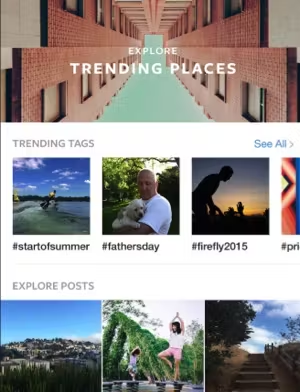
First is the new Explore tab, which makes it easier for users to connect with new content and with other users. The revamped tab features four main components: Discover New People, Trending Places, Trending Tags and curated content. These tools give guests and potential guests more ways to connect and engage with your property. Instagram also developed a Places search, allowing users to search for your property and see all the photos that previous guests have geo-tagged there. From there, it’s a small leap to picture paid, targeted content right in line with your search results.

Next, it’s all about resolution. Those 70 million photos a day will soon look better than ever. The former standard of 640 x 640 pixels is going to be upgraded to 1080 x 1080. It’s a move made to accommodate larger screens, like the one on the iPhone 6 Plus. While regular Instagram users can appreciate the HD upgrade, it’s an advancement that will be instrumental in rolling out a robust advertising platform. Advertisers expect high-quality video and crystal-clear imagery across all devices when they’re shelling out big bucks to reach such an active, engaged audience.

Facebook has made an art out of getting the right piece of content in front of the right audience, and with Instagram we can expect this only to get more precise. The photo-sharing app will likely be plugging into the larger Facebook targeting abilities — meaning demographics, location and interests will be leveraged to get your content in front of the right audience.

So prep yourself, hotel marketers — here come the ads and an incredible opportunity. Expect these opportunities to arrive in between regular programming like lobby shots and pool selfies before the end of the year. Instagram has slowly been acclimating users to the appearance of sponsored content, but what started out slowly has suddenly begun to pick up steam.

When it comes to events at your hotel, your dedicated team works like a well-oiled machine to pull off the impossible. From catering to lighting, no detail goes overlooked, and by the time attendees begin arriving, everything is perfect. Or is it?

If you’re not fully integrating social media into your events, you’re missing a huge piece of the puzzle. It’s a way for hotels to enhance the guest experience and extend the visibility and shelf life of a dazzling event.

Whether you’re looking to start from square one or simply need a quick refresher, I’ve put together a brief checklist you might find useful.

  1. Create a timeline for potential content opportunities, a shot list for essential photos to capture, and a Facebook Event page.

  2. Use shortened links and a unique hashtag to track clicks and engagement. Point guests in the right direction by including on-site materials with prompts, hashtags, and account handles.

  3. Publish content across various social channels, prior to, during, and after the event, and create ads that drive traffic to your event page.

  4. Watch for questions, comments, and engagement and tag any relevant brands, pages, or people. Be on the lookout for posts that use geo-tagging and other indirect mentions of the hotel or event.

  5. Create photo albums and recap posts for various social channels. You can even get extra mileage well into the future with throwback or #TBT posts.

  6. Measure and analyze. See who was talking and what sort of content was successful, and use those data points to make your next event even more dynamic.

Here’s just one example of how a hotel smartly supported its social events through social media: The Ritz-Carlton Chicago (A Four Seasons Hotel) hosted a bridal event on THE dec, the hotel’s outdoor bar, on August 13 featuring spring 2015 bridal gowns.

On the day of the event, the hotel live tweeted and posted photo contents to its brand channels using relevant hashtags such as #WeddingWednesday. The property also actively engaged on photos posted by partners and attendees of the event through channels such as Instagram.

Following the event, the hotel posted a video from a presenting partner highlighting the event and dresses on Facebook.

READ MORE AT HOTELSMAG.COM