

CHANGING HOW HOSPITALITY DOES SOCIAL

Tap Into Your Emotions

For years, sentiment in social media was imprecise, especially when compared to human behavior. Think about it. When someone says, “It’s fine,” it can be interpreted with a lot of different meanings, depending on the context. Humans give clues about these meanings through body language and other cues that indicate the feelings behind what is being said. Emotions are important to the communication equation. And yet, most social media marketing relies on cold metrics to determine sentiment, oftentimes devoid of human context. What can be measured, such as post engagement, shares, or reach tells you little about how your audience feels about your brand. Without that information, you can’t really tell what people are saying about you. Is your audience sharing your posts to make fun of you, or are they singing your praises? Using rapidly improving technology for sentiment analysis, brands can now monitor social media to understand more about what customers are saying, what it means, and what they can do about it.

What Is Sentiment Analysis in Social Media?

Sentiment analysis is a process of social listening in which words are analyzed to study the emotions and feelings of the text. Expressions are classified as positive, negative, and neutral. This eases the labor of sorting through thousands, of social media posts that might potentially lead to a PR nightmare–or a success story. You can use sentiment analysis to monitor brand perception, including negative talk, customer service tickets, and opportunities for amplifying testimonials.

What Tools Are Available for Sentiment Analysis?

BCV uses Amazon Comprehend to process information in social media posts. Every word in a message is analyzed and tagged with a specific sentiment. This program has been used in Amazon’s network, which has years of data to train the machine to make it more effective and offer accurate results. This information can then be presented to the brand team to help deal with positive and negative posts quickly. For example, incorporating sentiment analysis into your marketing strategy can help you identify times when you pick up more positive reviews and when you receive negative messages. This information can translate into actionable ways to improve the guest experience and gain a stronger share of voice among competitors. The more you analyze, the better you get.

Applications of Sentiment Analysis in the Hospitality Industry

The hospitality industry probably gets more chatter online than any other. If you want to know how your audience is feeling about your brand, sentiment analysis is the ticket. Sentiment analysis can not only monitor social media sites, it can also be used to monitor review sites. Trying to monitor every platform on your own can be time-consuming. Sentiment analysis can handle a large amount of data while giving you the information you can act on to make your business better.

At BCV, we use sentiment analysis to score your performance and to find ways to increase the number of positive comments. Our timeline helps you see your audience’s attitude toward your business. This information can be compared to our industry benchmark of sentiment analysis to know how you are doing.

Data doesn’t exist in a vacuum. There may be events going on in the world that impact your industry and affect how people feel about your destination. Sentiment analysis gives you more input about your messages that accounts for such external influences.

Sentiment analysis can also be deployed to push content and positive messages to boost your reputation. You can engage with customers when it makes sense to join the conversation without being overly pushy. It’s a multiplier effect that amplifies the positive–and that can minimize the negative reviews. We also address negative reviews to show customers that you care about their experience.

At BCV, we look at each month’s report to see how customers are responding and to get ahead of the curve. Analyzing the data gives you insights into customer satisfaction before and after events throughout the month. Sentiment analysis can also help you understand your competitors and how your audience is talking about them.

In the hospitality industry, one bad review can easily become a PR nightmare. Too often, the bad reviews hide the positive ones. Staying on top of how your audience feels about your brand helps you manage your reputation. Sentiment analysis gives you the edge in social media marketing.

For more information or to look at a sample report, let’s talk!
PART 1: The Start, Stop, Keep Strategy

What’s a social media audit? And what does a good one look like?

A social media audit is a top-to-bottom review of your social media efforts. At first glance, it might seem obvious. You know what channels you use. You post and look at the results. That’s an audit, right? Yes and maybe not. Taking the audit a couple of steps further allows you to have a solid overview of what’s working, what’s not and what could be improved.

I like to implement the feedback process known as “Stop, Start, Keep”. I learned about this process during my training to become a yoga instructor. It is a great way to make sure that when in the feedback process we are not stuck too much in either the positive or the negative. It gives balance. When working with others it’s beneficial in giving the good and the bad.

Sometimes one of the three is harder to identify. Evaluating based on Stop, Start, Keep encourages you to take a deeper look at all aspects of the social media audit.

Start

The Start relies on an understanding of trends and a willingness to be on the cutting edge of the platform. Over the past year, the application of Reels on Instagram created a need for research and education to be on the forefront of that trend. It wasn’t chasing trends, it was auditing the new opportunities and evaluating the benefits.

Stop

For Stop, I look at the performance of content over the past 3-6 months and evaluate the lowest performing content. It is very tempting to concentrate on reports that only feature the top performers. Rarely do the lower performers get noticed–and we know why! However, to evaluate them is a great way to learn more and identify what caused it to underperform–and maybe try again. Or not.

Keep

Keep is tricky. It doesn’t always imply what has the strongest upward trends. Over the past year of data, let’s look at, say, Reels again, and if over the past year there is an increase in engagement then you want to keep implementing and improving. Keep isn’t about staying where you are and being stagnant. It is identifying the trend that is working and taking it further.

Why is it Important?

Social media audits are important because the platforms, trends and algorithms are constantly changing. Without regular review, a process that worked for you last year could be tanking your performance in the current year.

Ready to get started? Check out this detailed Hotel Social Media Audit Checklist in a separate blog post.

Coming soon: An incredibly thorough (but easy) checklist!

Hashtags have been an invaluable social media tool, ever since its first use on Twitter, where social technology expert Chris Messina is credited to have come up with the very first hashtag, posting a tweet in 2007 reading: “How do you feel about using # (pound) for groups. As in #barcamp?” Messina created the hashtag with the intention to use it for aggregating discussions online regarding Barcamp, a user-generated technology conference around the world.

Exploding from its start on Twitter, hashtags have transcended their strictly social media use and can be found in today’s pop culture, fashion trends, and even on Jimmy Fallon. They have become infamous in society for satirizing social media and its importance in our everyday lives (#blessed). However, the fact remains that despite its pop culture reputation, hashtags are valuable components of a social media strategy.

There’s still an air of mystery surrounding hashtags: what are they actually used for? How many can you use? Which ones should you use? We sat down with members of our brand team to debunk the hashtag mystery and get insight for this social media enigma.

Why are hashtags so important for a brand’s social media strategy?

Hashtags act as a growth contributor; they expand your engagement, visibility, and, if used correctly, can increase your following. Placing a hashtag in an Instagram post not only gives the audience insight on the topic of the post, but also gives you the ability to join the conversation of that hashtag. For example, if you search the hashtag #onthetable, popular for food posts, you’ll see beautiful entrées, tables covered with dishes, and delectable desserts, all tagged with #onthetable. The benefit of a hashtag is that it’s a searchable, trackable tool—you’re able to find your post among the many included in that section and, more importantly, others are able to find it when they search that particular hashtag.

What are the benefits of hashtags?

Hashtags give you control of where your post goes, how it’s seen, and who sees it. Say you want to be associated with a certain luxury travel aesthetic. By tailoring your post with trending hashtags that focus on luxury travel, you can insert your brand into that particular online conversation. Another benefit of hashtags is the inspiration you can draw from them. Not only can a hashtag introduce you to a new brand or influencer with interesting social media techniques, but they can also help with trend forecasting. With Instagram always changing and evolving, what’s popular in January might not be popular in August.

Where should you use hashtags?

To fully take advantage of them, hashtags should be limited to social media, specifically Instagram. You’ll get the best usage out of hashtags when they’re accompanying an Instagram post, because it’s appropriate/accepted to include more than one in a post. When it comes to Twitter or Facebook, best practices recommend only using a hashtag if it is tailored for a specific campaign, content series, or brand, i.e. #TravelTipTuesday.

This is because Instagram users actively search the platform using the hashtag as a tool to find posts under a particular category. As a result, when you include more than one hashtag, you better your chances of being found through multiple searches. This practice also looks much cleaner in an Instagram post, where you’re able to hide multiple hashtags in the first comment of the post.

What are some Dos and Don’ts regarding hashtag best practices?

  • Do: Use them on Instagram with topics and inspiration you want to be associated with.

  • Don’t: go overboard with them (even though you can use up to 30 on a post, we don’t recommend using that many).

  • Do: Tag your overarching brand or slogan, especially if your brand has a parent hashtag (i.e. #MarriottHotels or #TravelBrilliantly)

  • Don’t: Use hashtags that are overly popular. If you have a breakfast post going out, we don’t recommend tagging the post with #eggs—that particular hashtag has over 10.5 million posts, and odds are your post won’t be seen.

  • Do: Include hashtags on Instagram Stories. They’ll aggregate into a larger conversation that lives outside your feed and your followers.

  • Don’t: insert a luxury brand into a conversation where the type of person isn’t your ideal traveler. You want to be associated with the right audience.

Where does this leave us?

An underrated social media tool, hashtags are essential to being part of the digital conversation. If you’re a small, growing brand, they’re vital to boosting your engagement and expanding your audience. If you’re a large brand that has already amassed a considerable following, hashtags allow you to introduce new topics and ideas to your audience. Whatever your brand, audience, or strategy, using hashtags effectively is your key to success on social. Trust us, you’re well on your way to #winning.

Special thanks to BCV’s Brand Team for their help with this post and their invaluable knowledge on hashtags!

Whether it’s discovering a charming city tucked into the summery climate of South Carolina or trekking up an island volcano for a breathtaking view of the Pacific, there’s just something about exploring a new destination for the very first time. Despite our infatuation with our home base in Chicago, one of our favorite parts of our job is discovering the many gems hidden throughout the world. 2017 was a great year for pushing our boundaries and getting out in the world, and we want to share a few of our favorite trips with you.

Maui, Hawaii (Grand Wailea)

If, in your life, you have the opportunity to go to Hawaii, then by all means, go to Hawaii! The moment we stepped through the doors of Grand Wailea, we knew it was going to be an amazing trip. From navigating the beautiful Haleakala National Park to making some aquatic friends sunning on Wailea beach, Maui completely stole our hearts.

Charleston, South Carolina (Renaissance Charleston)

As anyone can tell you, it’s not hard to fall in love with the charm of Charleston. We loved strolling along rainbow row to see the beautiful houses dotting the streets, and we kicked back with delicious sips and bites at all the local hot spots. Our suggestion? Discover the beautiful southern touches of Nathaniel Russell House.

Riviera Maya, Mexico (Rosewood Mayakoba)

They say life is better by the beach, and when it comes to Cancún, we couldn’t agree more. Every spot you explore in is teeming with color and life. From strolling the pristine beaches to savoring every bite of delicious cuisine, you feel like you’re in the most exotic place on earth. Grab a spot on the sand and start relaxing.

Sedona, Arizona (L’Auberge de Sedona)

When was the last time you took a look in your own backyard? The United States has no shortage of breathtakingly beautiful hidden treasures, one of them being Sedona, Arizona. Get an early start to the day and hike the Cathedral Rock at Red Rocks State Park for an all-around amazing view. We guarantee you won’t regret it.

Osaka, Japan (Conrad Osaka)

Stepping through cherry blossom trees to take in the modern skyline of Osaka, Japan is an adventure everyone should experience. We can attest that the rich history and bold architecture make this city a must-see. After visiting the breathtaking Katsuo-ji temple to navigating the bustling streets downtown, you’ll never want to leave the exciting city of Osaka.

Those were some of our top trips of 2017, but there are so many more we looking forward to taking! We’ll keep you updated as we continue to globetrot.

BCV’s Top Trips of 2017: And Why They Should Be on Your List was written by Charlotte Williams, Junior Copywriter and photos were taken by Angela Terimer.

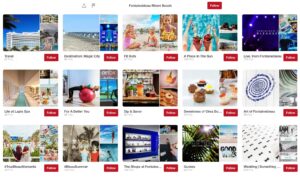
How do you define Pinterest? Is it a social network? The ability to comment, pin and message other users surely makes us think so. A source of inspiration? From pinning wedding dresses to DIY Christmas decorations, we flock to Pinterest to inspire future ideas. However, according to Zoe Pearson, Marketing Manager at Pinterest, we should actually be defining Pinterest as a “visual discovery tool.” But what exactly does this mean?

Pinterest combines social with search and inspiration, making it a completely unique platform. So, defining Pinterest solely as a social platform will place businesses and marketers at a serious disadvantage and tackling Pinterest the way you might address Facebook, Twitter, or Instagram in a marketing plan would simply be a mistake. Pinterest is an entirely different beast. In order to take full advantage of this platform, it’s essential that you abandon everything you think you know about traditional social media.

It’s important to realize that Pinterest is not about real-time engagement, wordy posts, discussing controversial topics, or connecting with friends from the past. Pinners are forward thinkers, optimists and linear discoverers who focus on the quality of content. Pinterest users leverage the platform to plan, search for ideas, and ultimately make a purchase. And that’s where marketing comes in.

At Social Media Week in London, Pearson discussed the ways in which companies can use Pinterest to elevate their businesses.  She shared that businesses must personalize their content in order to get into the pinner’s mind. Pinterest defines a pinner’s journey as linear because they from one end to the other like magazines. They scan through the content and then hone in on something they want to explore deeper.  It is also important to recognize that pinner’s are planning for the future. Whether they are planning what to eat for dinner or where they want to travel, they plan in advance.

Ultimately, marketers should recognize that Pinterest isn’t a place to drive traffic. It is a space to create and share brand values, and an excellent way to stay relevant in a pinner’s, aka a potential customer’s, mind.